KIT - Karlsruher Institut für Technologie
← Back to Research
Imitation Learning

Imitation Learning

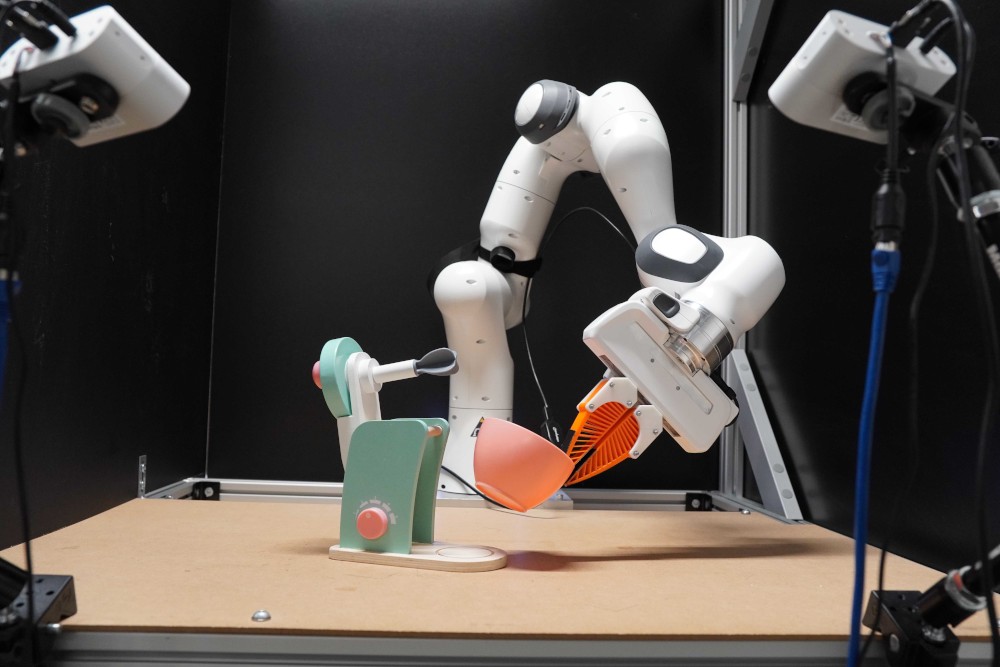
Our group works at the frontier of teaching robots to move and reason by observing human expertise. We specialize in scaling imitation learning across a vast spectrum of complexity from high-precision Diffusion Policies for specialized motor skills to large-scale Vision-Language-Action (VLA) models that bridge the gap between semantic understanding and physical execution.

We believe that for robots to move beyond simple automation, they must possess a deep, three-dimensional understanding of their environment. To achieve this, we move beyond 2D representations, integrating multi-modal inputs like Point Clouds to give our models the spatial awareness required for delicate, contact-rich manipulation.

Our research is grounded in the physical world. By deploying our methods on robots in both simulation and reality, we push the limits of long-horizon tasks - turning complex human demonstrations into robust, autonomous behaviors that can handle the unpredictability of real-life environments.

Key Areas

  • Multi-Modal Behavior Cloning
  • 3D Point Clouds
  • Vision-Language-Action Models

Members
Balázs Gyenes

Imitation Learning, Reinforcement Learning.

Aleksandar Taranovic

Reinforcement Learning from Human Feedback, Imitation Learning

Nicolas Schreiber

Computer Vision, Imitation Learning, Robot Grasping.

Xiaogang Jia

Imitation Learning, Offline Reinforcement Learning.

Xinkai Jiang

Imitation Learning, Human-Robot Interaction, Robot Grasping.

Enes Ulas Dincer

Imitation Learning, and Human-Robot Interaction (HRI)

Emiliyan Gospodinov

Vision-Language-Action Models, Reinforcement Learning

Qian Wang

Imitation Learning, Vision Foundation Models, Vision-Language-Action Models

Florian Seligmann

Vision-Language-Action Models, Imitation Learning, Uncertainty Quantification

Recent News

New Humanoid Robots

We have three new humoid robots from Unitree available for research:

  • Unitree H1-2: Human-sized humanoid, primarily for manipulation tasks
  • Two Unitree G1: Child-sized humanoid for locomotion and mobile manipulation tasks

Publications

2025

PointMapPolicy: Structured Point Cloud Processing for Multi-Modal Imitation Learning

PointMapPolicy: Structured Point Cloud Processing for Multi-Modal Imitation Learning

Xiaogang Jia, Qian Wang, Anrui Wang, Han A Wang, Balázs Gyenes, Emiliyan Gospodinov, Xinkai Jiang, Ge Li, Hongyi Zhou, Weiran Liao, others
Preprint · 2025
IRIS: An Immersive Robot Interaction System

IRIS: An Immersive Robot Interaction System

Xinkai Jiang, Qihao Yuan, Enes Ulas Dincer, Hongyi Zhou, Ge Li, Xueyin Li, Julius Haag, Nicolas Schreiber, Kailai Li, Gerhard Neumann, others
CoRL · 2025
X-IL: Exploring the design space of imitation learning policies

X-IL: Exploring the design space of imitation learning policies

Xiaogang Jia, Atalay Donat, Xi Huang, Xuan Zhao, Denis Blessing, Hongyi Zhou, Han A Wang, Hanyi Zhang, Qian Wang, Rudolf Lioutikov, others
ICLR 7th Robot Learning Workshop: Towards Robots with Human-Level Abilities · 2025
Beyond Visuals: Investigating Force Feedback in Extended Reality for Robot Data Collection

Beyond Visuals: Investigating Force Feedback in Extended Reality for Robot Data Collection

Xueyin Li, Xinkai Jiang, Philipp Dahlinger, Gerhard Neumann, Rudolf Lioutikov
Preprint · 2025

2023

Adversarial Imitation Learning with Preferences

Adversarial Imitation Learning with Preferences

Aleksandar Taranovic, Andras Gabor Kupcsik, Niklas Freymuth, Gerhard Neumann
ICLR · 2023

2022

Inferring Versatile Behavior from Demonstrations by Matching Geometric Descriptors

Inferring Versatile Behavior from Demonstrations by Matching Geometric Descriptors

Niklas Freymuth, Nicolas Schreiber, Philipp Becker, Aleksander Taranovic, Gerhard Neumann
CORL · 2022

2021

Versatile Inverse Reinforcement Learning via Cumulative Rewards

Versatile Inverse Reinforcement Learning via Cumulative Rewards

Niklas Freymuth, Philipp Becker, Gerhard Neumann
Preprint · 2021